

Moving is never an easy task. It might seem like a simple to-do list until it doesn’t. Whether it is a residential move or a commercial relocation you will be presented with challenges once you get down to the real thing. You can even say that relocating an office with dozens of desks, hundreds of cables and other stuff is definitely more challenging than a residential move. And that is exactly why you need a team that provides office relocating service. The success of the relocation lies in its coordination. Everything in your office has to arrive in the most pristine order. Even the costliest equipment has to arrive safely so you can start using it the next day. This guide explains how movers handle a large office move and how they cover each step carefully.
Why Large Office Relocations Require Detailed Coordination
A large office has so much equipment and furniture and all the other paraphernalia that have to be moved carefully. Each has its own set of rules regarding safety and dismantling. This has to be followed precisely. And while transporting the goods, you may realise that the building management has limited lift times. So you cannot use the lift as you planned.
Not to speak of the IT equipment – they have to be switched off and on again in a set order. Which means the staff could lose their working hours. This is where coordination becomes important because if one part goes wrong.
Surveying Office Furniture, Equipment, and Workstation Requirements
The relocation job begins with a site visit. The movers visit both buildings – your current building and the building where you are relocating to. They will take an inventory of all furniture and equipment. This will help them document any items requiring special handling – like servers, glass or large conference tables.
They will analyse the moving path: doors, stairs, lifts, loading areas and parking. This will help the moving company to decide on the number of trucks and crew required.
Creating a Relocation Plan for Different Departments
The relocation team will then create a plan that will be well-aligned with the different departments in your office. Some will be moved over the weekdays and still other equipment may be moved over the weekend so the staff do not lose work time. The plan will be perfectly charted – what should be moved and when. In bigger offices archives and spare furniture will be moved first and core teams last.
Labelling Workstations and Tracking Items During Packing
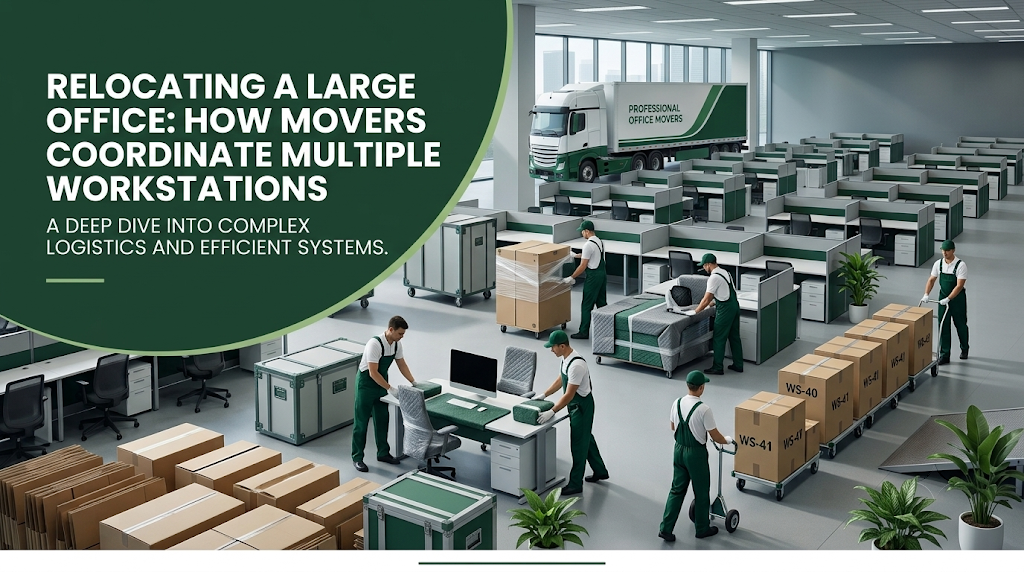
While dismantling IT equipment and workstations, the moving team will label everything. This is how they keep a big move under control. Each item gets a label with its department, desk number and destination. The labelling will show the crew exactly where each item goes. Experienced movers will colour-code by department and desk number. This will help them to unpack and place them without asking questions.
Dismantling Desks, Partitions, and Modular Office Furniture
All the big and modular furniture will be dismantled – desks, partitions, shelving and storage units. Movers will label the pieces and keep the fittings in marked bags and then rebuild them properly at their location. They will pad furniture with blankets to avoid scratches.
Packing Computers, Monitors, Printers, and Office Equipment
Just like furniture, IT equipment also needs special care. It would be best if the staff could back up data and shut down computers before the move. The movers will label cables, wrap the screens, servers and other electronics carefully so they don’t move in transit. They will box printers, phones and label them too so everything will be in the right order.
Planning Transportation and Delivery to the New Office
Choosing the right transport vehicle is the most important thing. Movers arrange permits and check building rules. They will book the elevators in both the buildings and organise everything carefully.
Professional movers use closed, GPS-tracked trucks. There will be a supervisor responsible for the move so everything will be loaded and unloaded carefully.
Reassembling Furniture and Positioning Workstations
Once the new office is reached, the moving crew from the office moving company will start unloading and place each item according to the floor plan. Desks are assembled and partitions and workstations are put in position. Then computers and monitors are set at their spots.
Managing Missing Items, Delays, and Installation Issues
With a correct moving plan there is usually nothing that can go wrong, but even then the moving team will refer to their checklist to see if everything has been picked up and delivered. Any item that is missing or damaged is noted straight away.
Why Choose Candid Movers for Office Moves?
As a trusted office moving service provider, Candid Movers handles office moves in Abu Dhabi. We take care of both small offices and multi-floor moves. We will first survey your site, plan around your hours, label by department and desk. During the move we will ensure the doors, walls and elevators are protected from scratches and scuff marks to protect lifts. We will also handle building permits.
Conclusion
A large office move works with a nice, fool-proof plan. Working with professional movers like Candid Movers will ensure success and a good and systematic move plan.